
A tenant rep broker is a commercial real estate broker who works only for the tenant in a lease or purchase: defines what the business needs, finds and underwrites the options, negotiates against the landlord, and manages the deal through the signed lease. The landlord pays the fee. At The Giles Group that is the whole business, across office, industrial and retail, and we never take the landlord's side of a deal.
Those three sentences answer the questions most people searching this phrase are asking. The rest of this page is the detail: what the work consists of week by week, how the fee actually moves, what a represented tenant gets that an unrepresented one does not, and the conflict that most pages on this subject leave out.
What tenant representation is, and what it isn't
Every commercial lease has a broker in it. The landlord hires a listing broker to fill the building, and that broker's job is to get the highest rent, the longest term and the fewest concessions the market will bear. That is not a criticism. It is the assignment.
A tenant representative is the other side of that table. The engagement starts with the tenant's business, not with a building, and the broker's obligation runs to the tenant alone. When the lease is signed, the tenant rep has one client in the room and the listing broker has one client in the room, and the lease reflects a negotiation between two represented parties.
What tenant representation is not: a "full-service" brokerage that lists buildings for landlords on Monday and shows them to tenants on Tuesday. Most brokerage firms in Nashville do both, including the national ones. The individual broker may be careful and competent. The firm still earns its largest fees from landlords, and the tour list, the recommendation and the pressure to close all live inside that fact. We cover how to test for it below.
A tenant who walks into a building without a broker is not in an unbrokered deal. They are in a brokered deal with representation on one side.
Who pays a tenant rep broker
The landlord does, in almost every lease transaction.
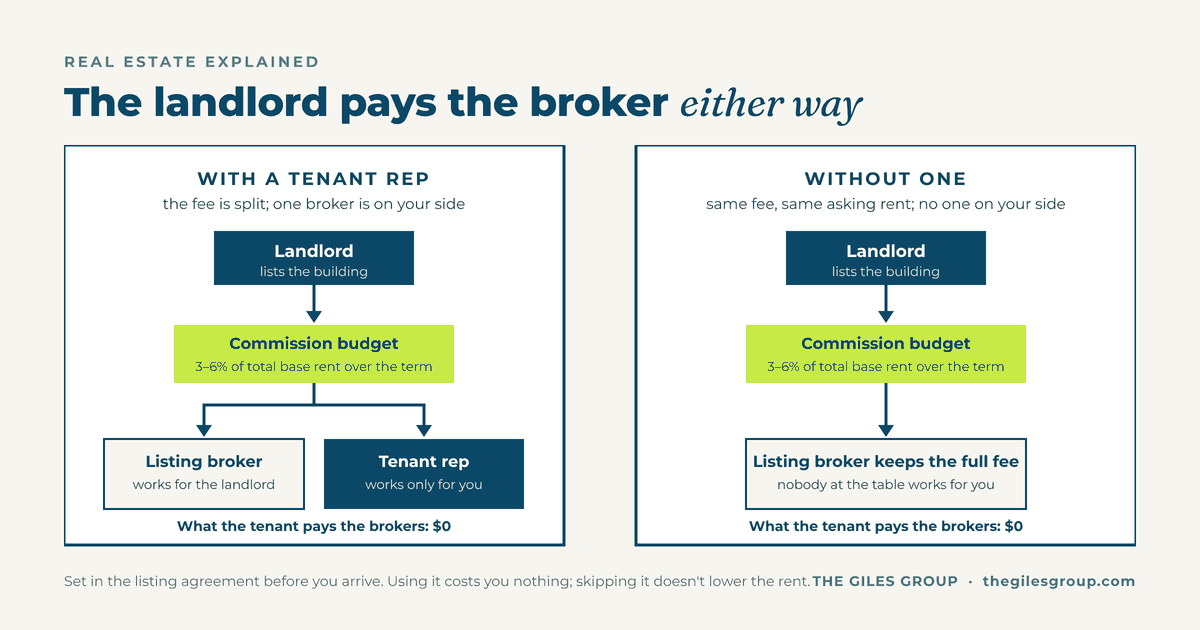
When a landlord lists a building, the listing agreement sets aside a commission, calculated as a percentage of the total base rent over the lease term, and states how it is split if the tenant brings a broker. In Middle Tennessee that total is commonly 3 to 6 percent, divided between the listing broker and the tenant's broker. The commission is a line in the landlord's underwriting for the building, the same as the leasing budget for improvements and free rent. It exists whether or not the tenant uses it.
That last sentence is the one to hold on to, because the most common objection to hiring a tenant rep is "I'll get a better rent if the landlord doesn't have to pay a second broker." In practice:
- If the tenant shows up alone, the listing broker typically keeps the full commission. The landlord's cost does not change, so there is nothing to pass back to the tenant.
- Landlords do not quote lower rents to unrepresented tenants. They quote the same asking rent to everyone and negotiate from there, and an unrepresented tenant negotiates from less information.
- The tenant rep's fee is paid at lease execution or commencement, by the landlord, under the listing agreement. The tenant never writes the check.
On a purchase, the mechanics are similar when the property is listed: the seller's listing agreement provides for a buyer's broker fee. On an off-market purchase there is no listing agreement, so the fee is set in the engagement letter with the client, either as a percentage of the price or a flat amount, and disclosed before any work starts. When we bought a ~3,500 SF office for Aspen Builders in Cool Springs, the property never came to market, which meant no listing broker, no competing buyers, and a fee structure agreed in writing up front.
What a tenant rep does, stage by stage
The work follows the same four stages on a 2,000 SF office lease and a 40,000 SF warehouse. Our version is Define, Underwrite, Create Leverage, Execute; other firms use other words for roughly the same sequence. What matters is what the client receives at the end of each stage.
1. Define the requirement
Before anyone tours anything, the broker documents what the business needs: headcount and growth, power and loading, parking, drive times for employees and customers, the budget, and the reason the decision is on the table at all. The deliverable is a written requirement that the rest of the process is scored against.
This is where the most expensive mistakes are avoided. Audio Advice came to us looking for flex space for a luxury audio showroom. The demographic work in this stage showed the customer base was in Franklin and the format was retail, and the search changed before an LOI was written. The ~6,500 SF showroom at Watson Glen is a different business than a flex bay off an interstate would have been.
Time: two to four weeks.
2. Underwrite the options
The broker surveys every building that could satisfy the requirement, including ones not on the listing services, and models total occupancy cost for each one over the full term: base rent, escalations, NNN pass-throughs or base-year exposure, the improvement allowance against the actual buildout cost, and the value of free rent. The deliverable is a shortlist with a number next to each option that means the same thing.
Asking rent is a poor guide here. Two buildings quoted $2.00 apart can be identical over five years once operating expenses and concessions are in the model, and the cheaper one on the flyer is often the more expensive one on the lease. On a 124-month industrial lease for Dauer Manufacturing, modeling the full term for every shortlisted building, escalations included, is what separated options that looked alike in year one and gave the client a factual basis to challenge Prologis's opening position.
Time: three to six weeks, longer for industrial build-to-suit.
3. Create leverage
This is the stage an unrepresented tenant usually skips, because it only works with more than one building in play. The broker runs two or three options through letters of intent at the same time, so each landlord knows there is a live alternative, and uses the market data from the underwriting to push on rent, free rent, improvement dollars and the lease terms that cost money later: caps on controllable expenses, renewal options, a right of first refusal on adjacent space, termination rights, assignment language.
The Q3 2026 Nashville market report has the current texture. Suburban Class A office landlords are offering three to six months of free rent on five-year terms. On retail, where vacancy is 3.5 percent and nobody is cutting rent, the wins are in structure: on two recent heavy-buildout leases we secured $55 per square foot in landlord contribution and six to seven months free, with construction periods that start when permits issue rather than on a calendar date. None of that is in the asking rent. All of it was on the table because there was somewhere else to go.
The Salon Boutique lease in Murfreesboro closed 33 percent below the initial asking rate with up to 13 months at zero occupancy cost: a seven-month permit-triggered construction period with no base rent or NNN, then six months of free rent after commencement.
Time: four to eight weeks through LOI.
4. Execute the lease
The LOI sets direction. The lease creates the obligation, and the landlord's first draft routinely rewrites what the LOI said. The broker manages the redlines with the tenant's attorney, keeps the business terms from drifting, and stays through commencement, buildout and move-in.
Farmers Storehouse is what the stage looks like when a tenant has handled the LOI alone and then calls. The LOI for a ~24,000 SF Brentwood store had set a three-month security deposit. The landlord's draft lease asked for a cash deposit plus a letter of credit, five times the LOI figure, due at signing, along with an unlimited parent-company guaranty. Six rounds of redlines against NAI Nashville removed the guaranty, deleted an opening penalty, and fixed two five-year renewal options at 3 percent escalations with no market reset. The LOI had been fine. The lease was where the money was.
Time: four to ten weeks from LOI to signature, depending on the landlord's counsel.
After the lease is signed
The engagement doesn't end at signature for a firm that is actually advising. Universal Robotics has been a client since 2017: three industrial leases as the company grew from ~6,300 to ~24,500 SF, each closed 10 to 17 percent below asking, and then, when the business pivoted from hardware to software in 2026, a negotiated early termination that reduced the liability on roughly three and a half years of unexpired term. CDI Flooring renewed in the same ~5,700 SF facility with its expense caps carried forward because comparable alternatives had been toured first, twelve to eighteen months before expiration, before the landlord's leverage peaked.
When to start. Eighteen months before a lease expires on office or industrial, twelve at the minimum. A new retail location needs twelve to eighteen months because of the buildout. Landlords know a tenant with four months left has no alternatives, and they price accordingly. If you want a nudge at the right time, the lease expiration reminder sends one at 24, 18, 12 and 6 months out.
The conflict nobody on page one mentions
Search this question and the first page of results is written by brokerage firms that also represent landlords. None of them discuss what that means, so here it is.
A firm that lists buildings earns its largest, steadiest fees from the owners of those buildings. Every tenant it represents is also a prospect for one of its listings. The pressure is rarely explicit. It shows up as the listing that is always on the tour, the "preferred" building the landlord's broker suggested you call, the recommendation to take the deal in front of you rather than run a second option, and the deal that gets done a little faster because the firm is on both sides of it.
In Tennessee, a broker can represent both the landlord and the tenant in the same transaction with disclosure and written consent. The disclosure form is real. The incentive problem survives it. A broker collecting both halves of the commission has no financial reason to push the rent down.
The test is one question: Do you or your firm represent landlords? If the answer is yes, or sometimes, or "we have a separate team for that," you have learned what you needed to. There are good brokers inside full-service firms. There are no good brokers who can negotiate hard against a landlord their firm is also working for. We built The Giles Group as occupier-only for that reason, and the Hire a Tenant Rep guide has the rest of the questions to ask before signing a representation agreement.
What a tenant rep doesn't do
A tenant rep is not a lawyer. The lease is reviewed by the tenant's attorney; the broker's job is to keep the business terms intact and to catch the economic traps in the legal language before counsel bills for them. A tenant rep is not an architect or a general contractor; on a buildout, the broker coordinates the test fit, the contractor pricing and the schedule so the improvement allowance and the construction period in the lease match reality. And a tenant rep does not guarantee a rent number. The market sets the range. Representation decides where in the range you land, and what the lease says about the next ten years.
When you don't need one
Some situations are too small or too short for the process to earn its keep. An executive suite or coworking membership is a license, not a lease, and the pricing is published. A sublease of a few months is usually best handled directly. A renewal where the landlord has already offered terms at or below market, in writing, may need an hour of review rather than an engagement; we will tell you that on the first call. Every competent tenant rep has a minimum assignment size for the same reason, and ours varies by property type.
Above those thresholds, the fee is paid by the landlord either way. The only question is whether you use it.
Tenant representation FAQ
What does a tenant rep broker do?
A tenant rep broker represents only the tenant in a commercial lease or purchase: documents the requirement, surveys and underwrites the options, negotiates rent, concessions and lease terms against the landlord with competing alternatives in play, and manages the transaction through the signed lease and move-in.
Who pays the tenant rep?
The landlord, out of the commission set in the listing agreement. The fee is split between the listing broker and the tenant's broker. The tenant does not pay it, and the rent is not lower without one; the listing broker simply keeps the whole commission.
Do I pay more rent if I use a broker?
No. Landlords budget the full commission when they list a building and quote the same asking rent to represented and unrepresented tenants. Represented tenants negotiate from market data and competing options, which is where the rent moves.
Can the landlord's broker represent me?
In Tennessee, yes, with written disclosure and consent. Whether you should allow it is a different question. A broker paid by both sides of the same lease has no financial reason to push the rent down.
What is the difference between a tenant rep and a commercial real estate agent?
Most commercial agents do both landlord and tenant work, often inside firms whose largest fees come from landlords. A tenant representative works only for occupiers. The license is the same; the conflicts are not.
When should I hire a tenant representative?
Eighteen months before your lease expires on office or industrial space, twelve at the latest. For a new retail location, twelve to eighteen months before you need to open. Leverage disappears as the expiration gets close.
Do tenant reps help with renewals?
Yes, and renewals are where representation is most often skipped and most often costs the tenant. A landlord negotiating a renewal with a tenant who has not looked at alternatives knows it. Touring comparable space before the renewal conversation changes the number.
What size lease is worth representing?
It depends on the property type and the term more than the square footage, and every firm has a minimum. The process has worked for us from ~2,000 SF of Class A office to ~40,000 SF of warehouse. If a requirement is too small for a full engagement, a good tenant rep will say so on the first call.
Start with a 30-minute call. We'll tell you what we see in the market, whether the timing is right, and whether we're the right fit. Schedule a conversation →
Lease expiring in the next 24 months? Set a free lease expiration reminder and we'll reach out at 24, 18, 12 and 6 months out.
Written by Shane Giles, MPRE, Managing Director of The Giles Group. Shane represents office, industrial and retail tenants across Middle Tennessee and never landlords. Before founding the firm he worked in accounting and finance at one of Nashville's oldest commercial real estate firms, and later managed more than $150 million of real estate a year across 600-plus commercial locations. Master's in Real Estate Development and Finance, Georgetown University.